

There are different explanations for Russia’s motive to attack Ukraine. One crucial aspect is often overlooked or underestimated: Russia’s interest in the significant resource wealth of Ukraine, particularly the enormous untapped natural gas reserves in the Black Sea.
In 2012, a first, smaller natural gas field was discovered in the Black Sea off the Romanian coast during test drilling. Since then, significant quantities of oil and gas have been found in the coastal areas of the neighboring countries (Turkey, Bulgaria, Romania, Ukraine, Russia, and Georgia), and large international investments have been made to exploit them. Estimates suggest that the Black Sea holds about 30,000 billion cubic meters of natural gas alone, which is roughly ten times the annual global consumption.
However, the test drilling for the corresponding development projects initiated by Ukraine in 2013 was interrupted by Russia’s annexation of the Crimean Peninsula, which is not internationally recognized. Since then, Russia has claimed not only the territorial waters belonging to Crimea but also large parts of the maritime territory belonging to Ukraine under the law of the sea. All the technologically advanced drilling platforms that had been erected for test drilling were militarily occupied. The maps illustrate the extent of the sea area controlled by Moscow since then (left) and the gas explorations annexed by Russia (right).
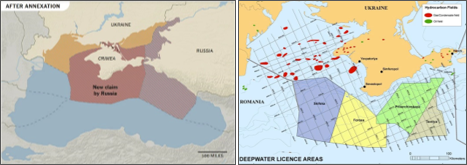
Before the war in Ukraine, Russian energy exports accounted for about 45% of the country’s gross domestic product. Now, the share is likely to be even higher due to Western sanctions and record prices for gas and oil.
In the past, there have been disputes between Russia and other countries over access to oil and gas or the control and distribution of energy to Europe. Russia has waged the so-called “Kremlin pipeline wars” with Belarus (2004), Georgia and Lithuania (2006), Turkmenistan (2009), and Syria (2015), among others. Putin wants to avoid at all costs that oil and energy pass Russia by and reach the European market. Not only because it would reduce Russia’s market share but also because it would make the importing countries more independent, resulting in painful power and economic losses in Europe. However, the Kremlin is also aware that the loss of the European energy market could be more than compensated for by demand from China and, especially, India.
With the resources found in the Black Sea, Ukraine has the largest European energy reserves after Russia. Estimates put Ukraine’s share of the Black Sea’s natural gas reserves at 5,000 billion cubic meters.
A look at the current course of the war supports the suspicion that Putin is primarily interested in Ukrainian resources: Mariupol, the major port city on the eastern Ukrainian coast of the Sea of Azov, was one of the first targets of the Russian army. At the same time, the fighting has shifted from the center of Ukraine to the south of the country along the western coast, as far as Odessa, where an increasing number of Russian air strikes are also being observed.
It is also clear that Russia was never seriously interested in capturing the capital and toppling the government in Kiev. The rocket attacks on Kiev and other cities in the center and west of Ukraine subsided after the first few days of the war and were possibly only diversionary maneuvers to conceal Russia’s true goals in this war.
For a few days now, Putin has been preparing his war rhetoric for the possibility of an eventual partition of Ukraine into regions as a solution to the conflict. He is surely not only thinking of Luhansk and Donetsk and their extensive grain and other natural resource deposits but also of the separation of the entire Ukrainian Black Sea coast. In addition, the sale of the resulting territories could bring significant income to Russia.