
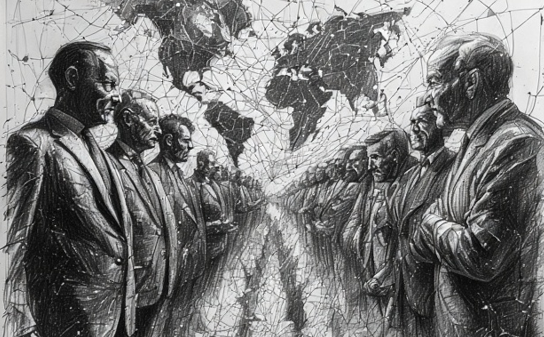
In some Western countries like the United States and Argentina, newly elected leaders have stirred strong winds of change. Meanwhile, nations such as the UK, France, and Germany – along with Canada, increasingly aligned with Europe’s ideological outlook – continue to drift further down a globalist path marked by deindustrialization, expanding censorship, radicalized climate policy, and even the normalization of war rhetoric.
In these countries, political parties that seek to fill the growing vacuum in the center are often ignored, sidelined, or misrepresented as far-right – with active support from parts of the mainstream media. At the same time, the boundaries of acceptable discourse are being redrawn, narrowing the Overton window to favor the dominant narrative. This has included the public shaming or political exclusion of individuals who, in the eyes of the establishment, express “wrong” opinions using “wrong” language.
Examples abound. In Germany, politician Hans-Georg Maßen was labeled an extremist by domestic intelligence for suggesting that a post-COVID reckoning was necessary. In France, opposition leader Marine Le Pen – head of the country’s largest opposition party – was, at one point, stripped of her eligibility to run for office due to what many considered a relatively minor legal violation. In UK homes are raided and people imprisoned for critical social media posts. In Romania, the European Union intervened in an election process under controversial circumstances – raising concerns about whether the move was a political test case or a desperate reaction to prevent an unfavorable outcome.
Across the board, freedom of speech has been an early casualty of these trends.
Social cohesion has suffered accordingly. The COVID period created an initial split – between those who supported and those who questioned the measures, lockdowns, and vaccines. In the years since, new dividing lines have emerged: over Ukraine and Russia, over Israel and Gaza, over digital currencies, climate, and even the EU itself. Yet despite this wide range of issues, polarization remains largely binary. A person’s position on one issue now often predicts their stance on the others.
Rather than fragmenting into a mosaic of small ideological camps people have consolidated into two increasingly incompatible blocs, making reconciliation appear less and less likely.
Even more surprising, perhaps, is the role played by business leaders, corporate executives, and ultra-wealthy individuals. Once historically skeptical of socialism, many now align themselves with progressive narratives across these topics. What we are witnessing is the rise of a new alliance: between economic elites who pursue influence and profit, and ideological actors who frame their power through moral and social causes.
Both groups operate from different motives – profit on one side, idealism (or the appearance of it) on the other – but they are not in conflict. In fact, they complement each other. The result is what some have called “billionaire’s socialism”: not socialism in the traditional sense of redistributing wealth downward, but a modern hybrid system where economic and political elites centralize control over both resources and behavior.
As Michael Klonovsky aptly put it: “Socialism has become a parasite of capitalism.”
This model reflects a deeper philosophical shift. The long-assumed antagonism between liberalism and socialism needs rethinking. Today, both ideologies rest on a shared materialist foundation and increasingly rely on the same instruments of control – administrative regulation, ideological conformity, and technocratic planning. This convergence results in a governance model similar to what Oswald Spengler described in The Decline of the West (1922): a late-civilizational structure characterized by mass bureaucracy, elite domination, and spiritual exhaustion. The modern version has been described – retrospectively – as “billionaire’s socialism.”
Of course, today’s elites understand that the middle class won’t voluntarily surrender its autonomy or assets. That’s why the shift must be gradual and never framed as coercion. Instead, it’s driven by narratives, and perhaps the most effective of these is fear.
Fear is a powerful instrument of control. Those who can credibly and consistently manufacture fear – be it of disease, climate, or war – gain enormous power over populations. Fear silences resistance, justifies exceptional measures, and sustains states of emergency.
The COVID era revealed how easily populations can be shaped by centralized narratives. The resulting surge of authority – reaching even to low-level bureaucrats – proved politically intoxicating. When crises are no longer just exploited but coordinated between political and economic elites, new patterns emerge.
From that perspective, several recent developments look less random:
- A virus becomes the pretext for suspending civil liberties.
- Climate change is reframed as a threat justifying surveillance, rationing, and control.
- War returns as a unifying fear-narrative, evoked by leaders echoing rhetoric once used in darker eras.
Even in Germany, the term “Kriegstüchtigkeit” (“war-readiness”), once associated with Joseph Goebbels, has re-entered liberal discourse – without irony.
Why does it all feel like it’s accelerating?
Because it is. And the reason lies not in secret coordination, but in structural incentives. The pandemic showed how easily a fearful population can be governed. At the same time, public morality has frayed. Political figures no longer step down over serious misconduct – and society no longer expects them to.
This moral disintegration spreads quickly among the ruling class. In such a climate, the path to authoritarian governance – or to Spengler’s vision of “late civilization” dominated by technocrats and plutocrats – becomes not just shorter, but smoother.
Crucially, this is no longer limited to individual countries. The COVID period triggered a synchronized transformation of state-society relations across much of the Western world. Only a few democracies – perhaps the United States and Argentina – have mounted partial resistance. In Europe, only nations like Slovakia and Hungary show signs of holding out. Within the EU system, however, meaningful course correction seems increasingly difficult.
What may appear to be manipulation or conspiracy is better understood as emergent order: a convergence of incentives among elite actors, reinforced by fear-based compliance and moral posturing. It is not the result of a single plan – but the byproduct of many self-serving actors operating within the same system.
But recognizing that structure is the first step toward change.
Because with understanding comes agency – and with agency, the possibility of resistance.
Not through panic. Not through tribal rage. But through awareness, disobedience, and the courage to call things by their real names.